 Zimbabwe's Power, Water and Sewage:
One System Collapsing, Not Three
By Sun Earth Energy Ltd, in association with Urbium Research Ltd
Zimbabwe doesn't have an electricity crisis, a water crisis and a sanitation crisis. It has one crisis, playing out across three 'pipes'.
That's the core finding of a diagnostic briefing prepared by Sun Earth Energy Ltd and its research affiliate Urbium Research Ltd, drawing on Auditor-General reporting, Human Rights Watch investigations and peer-reviewed epidemiology. The evidence shows that Zimbabwe's power grid, water treatment and sewage network are physically interdependent — and that chronic underinvestment in one has been quietly degrading the other two for two decades.
A grid with no margin for error
Zimbabwe currently generates around 866MW against a national demand of roughly 2,400MW — a shortfall that produces daily load-shedding of up to 16 hours even in ordinary conditions. But the more telling pattern is what happens when something goes wrong. In January 2024, a single busbar fault at the Insukamini substation in Bulawayo took down the entire national grid. In 2025, a fire at Harare's Highfield substation knocked out four neighbouring substations in one go, plunging Southerton, Old Ardbennie, Rugare and parts of Mbare into darkness. Most recently, a fault on the Warren–Alaska 330kV line again brought down power nationwide, forcing ZESA to pull emergency supply from South Africa, Kariba, Cahora Bassa and Hwange simultaneously.
That's not bad luck. It's what a grid with no redundancy looks like — and redundancy costs money that a 2019 forensic audit, commissioned by Zimbabwe's own Auditor-General, found had been diverted elsewhere: inflated transformer contracts, obsolete equipment purchases, and spending that never reached maintenance budgets at all.
The same story, underground
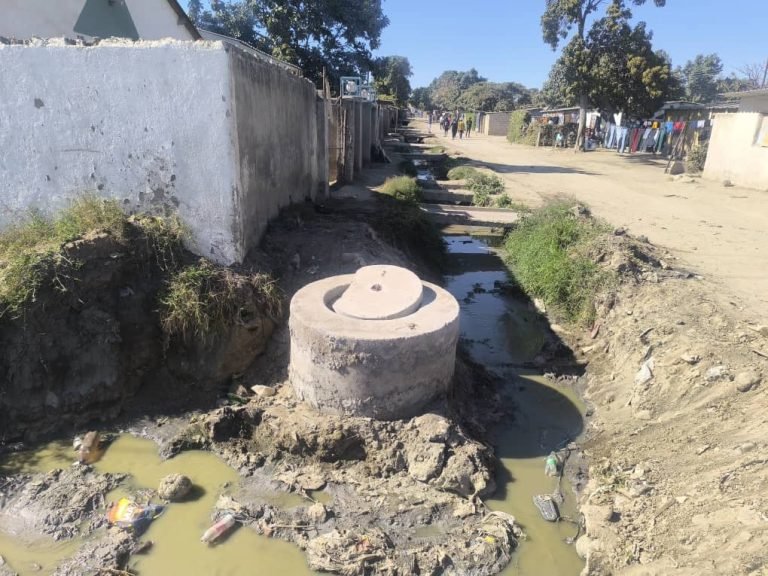
Harare's water and sewage network was built in the 1960s for a fraction of today's population, and it shows: the city produces around 704 megalitres of water a day against demand of 800–1,300ML. Human Rights Watch has documented the same pattern of revenue diversion here as in the power sector — funds meant for pipe maintenance and sewage infrastructure routed elsewhere. In 2024, a collapsed sewer pipeline — whose repair tender reportedly went missing — dumped raw sewage directly into Lake Chivero, the city's principal water source. Testing subsequently found E. coli, giardia, salmonella typhi and cholera bacteria in the water supply.
This is not a new problem. The 2008–09 cholera epidemic killed around 4,200 people and infected over 100,000 — the worst outbreak Africa had seen in 15 years. A 2023 peer-reviewed study in PLOS Neglected Tropical Diseases, using geospatial analysis of Harare, linked the 2018–19 outbreak directly to sewer bursts contaminating the piped water network.
Why "one system" matters
The reason to treat these as a single system rather than three separate ministries' problems is simple: water treatment plants and sewage pumps run on electricity. When a substation goes down, water pressure drops with it, and untreated sewage backs up. A grid failure is a sanitation failure, on a delay of hours or days. Managing them separately — as most policy responses do — misses the mechanism that actually drives outbreaks.
Zimbabwe is not unique in facing grid fragility; Nigeria's national grid collapsed to zero output three times in a single month earlier this year, and South Africa has its own well-documented history of cascading failures. What distinguishes Zimbabwe's case is the scale of documented diversion of the funds that would otherwise have paid for the maintenance and redundancy to contain these failures before they cascade.
The diagnosis, not the prescription
This briefing is deliberately diagnostic rather than prescriptive. It sets out the documented mechanism of failure — chronic underinvestment removing the redundancy a modern interdependent infrastructure system needs — without recommending a specific policy response. That's a judgment for governments, donors and Zimbabwe's own diaspora to make with the evidence in front of them.
What the record does make clear is this: a grid that loses its redundancy margin because maintenance funds have been diverted does not fail in isolation. It degrades water treatment, compromises sewage pumping, and reopens the door to waterborne disease that basic infrastructure exists to keep closed.
This article condenses a longer diagnostic briefing, "A Single Interdependent System in Collapse: Electricity, Water and Sanitation," prepared by John Burke, Director of Sun Earth Energy Ltd and Urbium Research Ltd (July 2026). Full references available on request.