- Details
- Written by: Rumbidzai Thelma Chidewu
- Category: Walk for Freedom
- Hits: 650
 Blackburn Walk for Freedom:
Zimbabweans in the UK Rise for Change
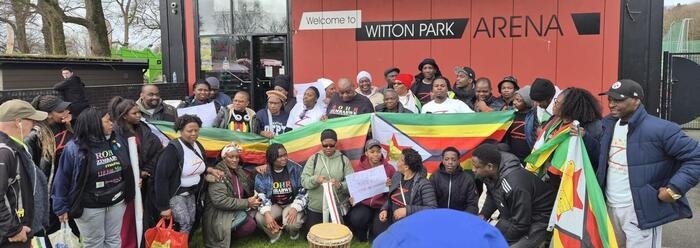
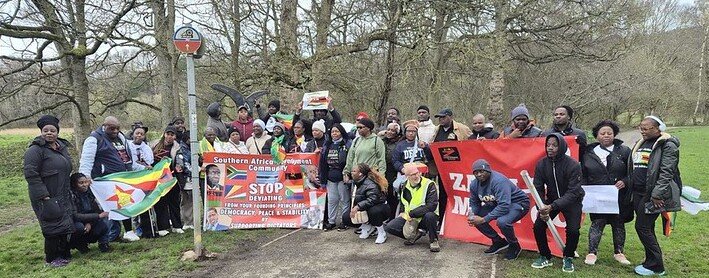
On 28 March 2026, the streets of Blackburn became a powerful symbol of resistance, unity, and hope as Zimbabweans from across the United Kingdom gathered for a Walk for Freedom. Travelling from different cities and counties, members of the Zimbabwean diaspora came together with one shared purpose: to stand in solidarity with those back home and to demand a better future for Zimbabwe.
This was more than just a march.
- It was a collective voice.
- A voice for justice.
- A voice for dignity.
- A voice for change.
Protesters called for the restoration of human rights, an end to political repression, and firmly rejected the “2030 agenda” and Constitutional Amendment Bill No. 3 (CAB3), which they say threatens to further weaken democratic processes in Zimbabwe.
“We Are Tired” — Voices from the Protest
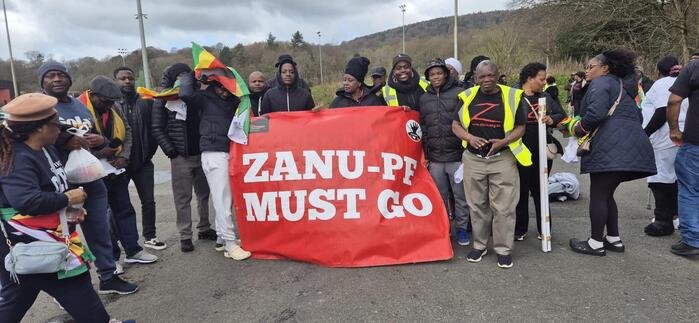 The most powerful moments of the march were carried not just in placards, but in the words and emotions of the people.
One protester summed up the frustrations felt by many:
“Taneta nekutongwa nemurume watisina kusarudza, taakudawo hurumende idzva ine ropa revechidiki.” (We are tired of being ruled by a man we did not choose; we now want a new government with young blood.)
This message resonated deeply throughout the crowd — reflecting a generation that feels excluded, unheard, and determined to reclaim its future. Many participants said they were marching not only for themselves, but for family members and fellow citizens in Zimbabwe who cannot freely protest without fear of intimidation or repression.
A Peaceful and People-Led Movement
Despite attempts to misrepresent the event, the Blackburn Walk for Freedom was peaceful, organized, and driven by ordinary Zimbabweans.
- There was no violence.
- No external control.
- No hidden agenda.
- Just people — united by concern for their country.
Participants dismissed claims suggesting the protest was sponsored or manipulated, describing such narratives as deliberate attempts to discredit genuine civic action.
“This was about us,” one marcher explained. “About our pain, our hope, and our demand for change.”
Challenging Disinformation
 In the aftermath of the march, concerns have been raised over misinformation being circulated about the protest. Organizers and participants strongly refuted these claims, urging the public to question and
critically assess the narratives being spread. They emphasized that disinformation is often used to shift attention away from real issues — including economic hardship, governance concerns, and the shrinking democratic space in Zimbabwe.
“The real story is not the lies being told,” another participant said.
“The real story is why Zimbabweans felt the need to march.”
A Growing Call for Change
The Blackburn protest is part of a wider and growing movement among Zimbabweans in the diaspora who are increasingly using their voices to advocate for change. Far from home, they continue to stand for the values of freedom, accountability, and justice. The message from Blackburn was clear and undeniable:
- Zimbabweans are tired.
- Zimbabweans are united.
- Zimbabweans are ready for change.
And as the march came to an end, one truth remained — this was not just a moment.
It was a movement.
- Details
- Written by: Blessing Tariro Makeyi
- Category: Walk for Freedom
- Hits: 711
 The Diaspora Says No To CAB3— And Means It.
Zimbabweans across the globe have demonstrated unprecedented defiance in response to what critics describe as a tightening grip by President Mnangagwa's leadership, marked by repressive legislative manoeuvres, the deployment of state apparatus, and alleged manipulation of the ongoing constitutional amendment process.
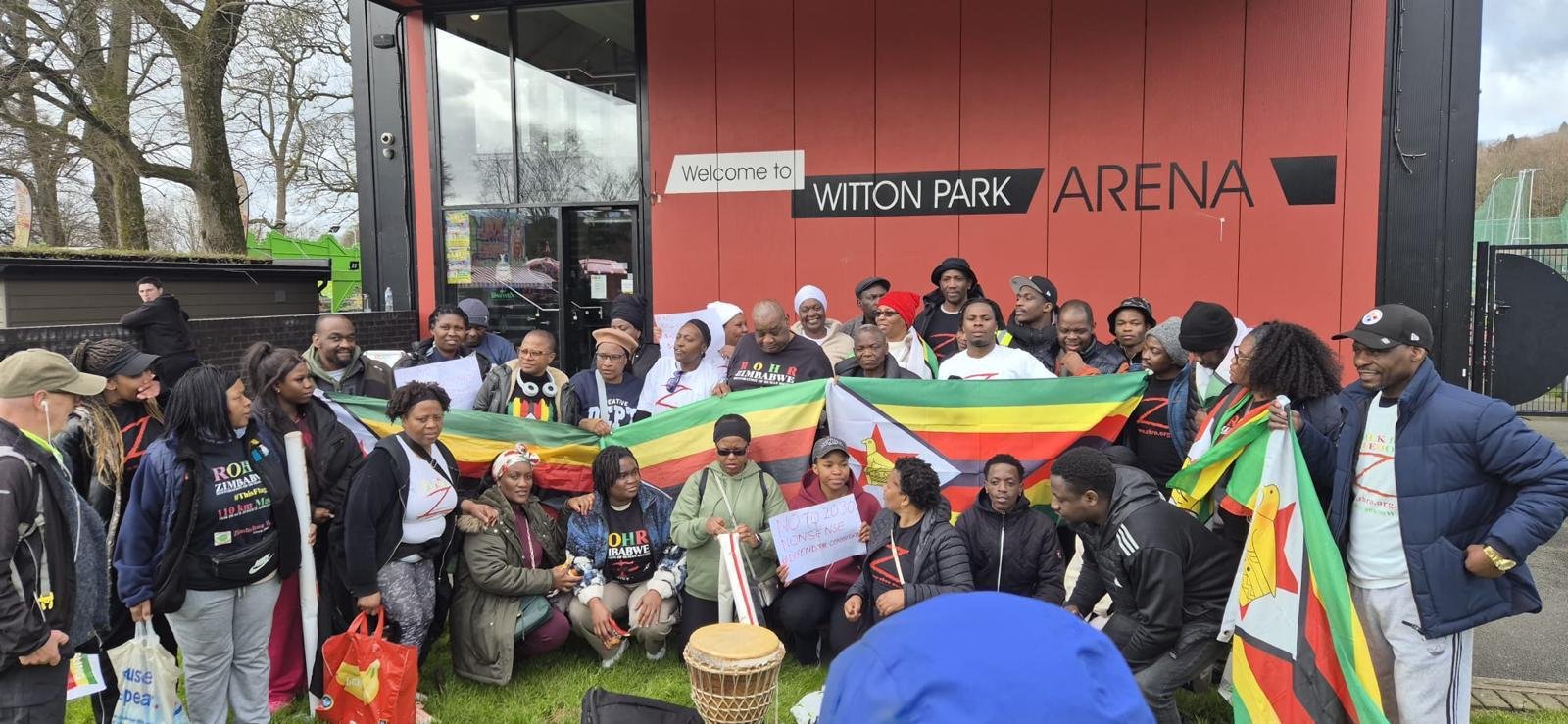
In the United Kingdom, Zimbabweans staged a "March of Defiance" {under the ZHRO "Walk for Freedom" concept} at Witton Park in Blackburn, where dozens of participants braved cold and rainy weather. Organisers said more than 50 people took part, having travelled from various UK cities and spent the night in nearby accommodation ahead of the event. (Bulawayo24)
The marchers were not merely protesting a bill. They were speaking from lived experience. Many in the diaspora were forced to leave their homeland due to prolonged political and economic instability, largely stemming from extended periods of leadership that failed to uphold accountability, transparency and good governance. The era of President Robert Mugabe, marked by overstaying in power, contributed significantly to the deterioration of Zimbabwe's economy, institutions and social fabric. (Bulawayo24)
(NewZimbabwe.com) Note the online survey below;
| The recently gazetted Constitutional Amendment Bill No. 3 proposes major changes, including extending presidential terms from 5 to 7 years and allowing President Emmerson Mnangagwa to remain in office until 2030. Do you support these proposed constitutional changes? |
|
For this generation, Amendment Bill No. 3 is not a new story. It is a familiar one — with a different name at the top.
Zimbabweans in the diaspora actively participated in national processes, including the Constitution Parliamentary Select Committee (COPAC), which culminated in the adoption of the 2013 Constitution. That constitution was a product of extensive consultation, sacrifice and the collective aspirations of Zimbabweans both at home and abroad. (Bulawayo24) To see it dismantled through legislative sleight of hand is, for many, a personal wound as much as a political one.
The diaspora's demands are clear. They call on Parliament to reject Constitutional Amendment Bill No. 3 in its entirety, uphold the integrity and spirit of the 2013 Constitution, and prioritise national interest, democratic governance and accountability over political expediency. (Bulawayo24)
The Bigger Picture: A Pattern of Democratic Regression
When Zimbabwe enacted the 2013 Constitution, former President Robert Mugabe had been in power for 33 years. (ConstitutionNet) That constitution was designed, in part, to ensure Zimbabwe would never again be held hostage by a single man's grip on power. The irony of its successive erosion under the man who removed Mugabe is not lost on anyone watching from Harare — or from Harlesden. Constitutional scholars have been unsparing in their assessment. The bill's cumulative effect is a fundamental reordering of the constitutional system which increases presidential authority while weakening mechanisms for popular participation and democratic accountability, exemplifying executive consolidation through constitutional disruption and accelerating Zimbabwe's ongoing trajectory of democratic regression. (Thezimbabwean)
The government insists it is modernising. Critics — across civic society, the legal profession, the Church, and the diaspora — respond that what is being modernised is the architecture of authoritarianism.
Conclusion: The Constitution Belongs to the People. The Zimbabwe Diaspora Vote Initiative has insisted that Zimbabweans living outside the country must participate in any constitutionally required referendum to decide on the proposed amendments, and that excluding them would violate their constitutional rights. (allAfrica.com)
This demand cuts to the heart of the matter. The 2013 Constitution is not ZANU–PF's document to rewrite at will. It is a social contract — built through blood, negotiation, and collective aspiration. Its entrenchment clauses exist precisely to prevent any government from dismantling democracy from the inside.
As the 90-day public consultation window closes and the May 2026 parliamentary vote draws near, one thing is clear:
the Zimbabwean people — whether in Harare, Bulawayo, Birmingham or Johannesburg — are not passive spectators in this moment.
They are witnesses, they are litigants, and they are, once again, being asked to defend a constitution they helped write.
The answer they are giving is unambiguous. No.
- Details
- Written by: Prince T Chidewu
- Category: Walk for Freedom
- Hits: 548
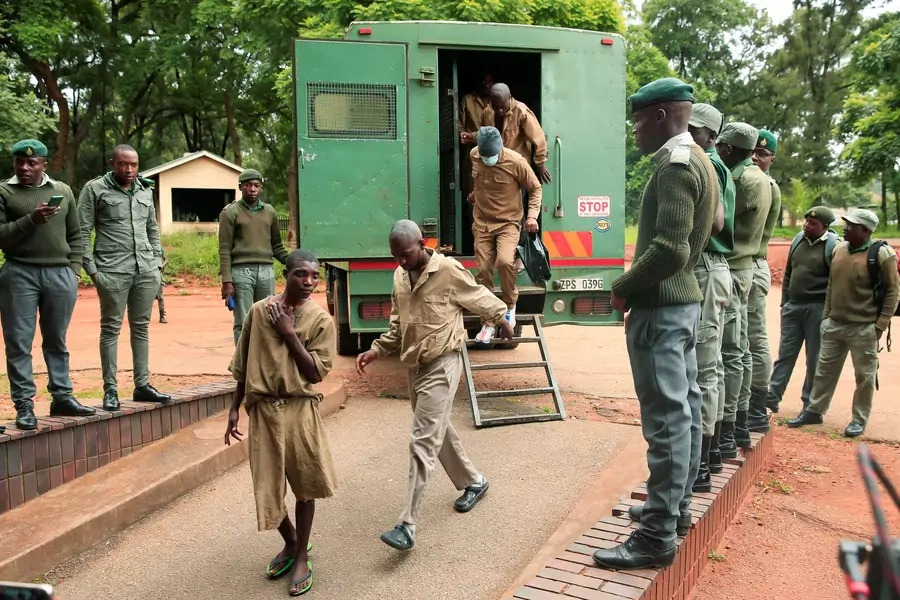 Growing Fear Forced Me to Seek Safety Abroad
My Life in Zimbabwe
I was born and raised in Zimbabwe, but growing up there was very difficult because of political problems and fear in the community. From a young age, I lived in an environment where people were not free and were always afraid of being targeted. There was constant tension, and many families, including mine, were affected by intimidation and harassment linked to political issues.
What Happened to My Family
As I grew older, I began to understand why my family was living in fear. My parents were targeted and mistreated because of political reasons. I personally witnessed them being harassed and threatened.
This was very painful for me to see as a child. It made me feel helpless and unsafe in my own home. There were times when I felt that anything could happen to us at any moment. Because of this situation, life was not stable. I struggled to concentrate on school, and I was always worried about my family’s safety. I could not live like a normal child because fear was always present. At that time, I was too young to protect my family or change the situation. I had no control over what was happening around me.
Why I Left Zimbabwe
At the age of 16, I came to the United Kingdom. Leaving my home country was not an easy decision, but it was necessary for my safety and my future. The fear I experienced in Zimbabwe, and the way my parents were treated, made me realise that I could not continue living there. I was afraid of what could happen to me if I stayed.
- Details
- Written by: Dickson Chikwizo
- Category: Walk for Freedom
- Hits: 602
 NO TO A CONSTITUTIONAL COUP ON ZANU PF'S ED 2030 AGENDA.
Zimbabwe's ruling Zanu PF party is actively organising nationwide campaigns to support the contentious Constitutional Amendment (No.3), which extends President Emmerson Mnangagwa’s term beyond 2028 to 2030 under the slogan "ED2030".
As activists and opposition organisations we describe it as a "constitutional coup" to keep the 84-year-old leader in power. Our WALK FOR FREEDOM Campain in Blackburn, Lancashire, UK on the 28th March 2026 is against this amendment. If there is a need to amend the Constitution, the government should call for a referendum and seek people's mandate.
The ZANU PF regime is trying something using an open ringing, without a procedural voting in a referendum. We do remember from a military coup in the year 2017 to this year's Constitutinal coup on our Constitunal amendment (No3) which they're seeking to extend.
We condemn the brutal torture of Professor Madhuku, the President of NCA and some of his party members who were brutally assaulted for opposing the Constitution amendment (Bill No3) on the 1st March 2026, and the CDF Convener Tendai Biti and his team who were arrested on the 21st March 2026 for opposing the amendment as well.
They're all being persecuted for opposing the Constitution amendment of the Bill (No3). This is a destabilising gamble. The ZANU PF regime’s agenda ED 2030 has been weaponised. Zimbabwe is not governed by a democratic rights but by patronage and stolen wealth, while citizens are suffering.
The reality in the ZANU PF regime is simply that they feel entitled to rule Zimbabweans for ever, by virtue of having fought the liberation struggle.
We are not going to stop Walking For Freedom until Zimbabwe is Free! Hope is keeping us walking when everything around our fighting is yet archived. Hope is our resilient spirit in refusing to surrender our WALK!!
WE ARE UNSTOPPABLE!!
- Details
- Written by: Samuel Jambaya
- Category: Walk for Freedom
- Hits: 1122
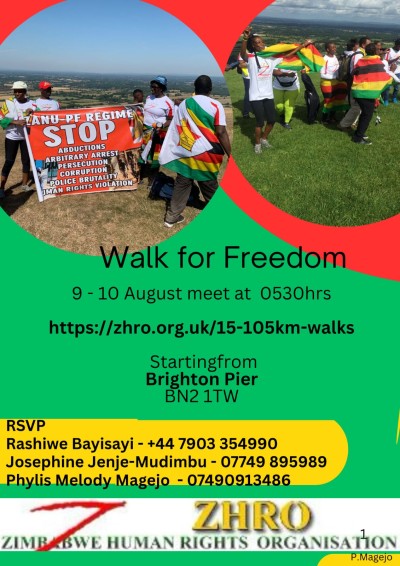 Activists Unite in Brighton to walk to London - 105km walk
Zimbabwe Human Rights Organisation (ZHRO) will lead the annual "Walk For Freedom" from Brighton Pier to Hampton Court, London
ZHRO courage mirrors that of many other Citizens Coalition for Change (CCC) activists who have suffered arrests, abductions, and torture simply for demanding change. For years, ZANU PF has governed through fear. But with bold steps the August 9–10 will not be remembered as just another pair of days in Zimbabwe’s political calendar. These will be remember as the days when brave citizens like:--
Rashie Bayisayi, John Burke, Samuel Jambaya, Melody Magejo, Josephine Jenje Mudimbu, Patson Muzuwa, Shepherd Yuda, Elizabeth Chitengo, Evy Kagandi, Mgcini Victor Hlophe, Nobukhosi Dube, Dickson Chikwizo, Tawandda Matangambiri, Ettar Patience Mhlanga, Shamiso Moyo, Velisiwe Ndhlovu, Kelvin T Mhlanga, Moses Mabno, Victor Simon, Genius Mamwadhu and Irene Munyaradzi - all stepped forward to walk for freedom—defying a system that thrives on fear, silence, and repression.
We are going to walk not in fear, but in defiance, not in silence but in the thunderous voice of people who refuse to be crushed. We walk for freedom – a freedom long overdue. A freedom stolen. A freedom denied.
Gathering across cities, villages, and hearts, united against a regime that has forgotten what it means to serve. ZANU PF, your time is up. Your betrayal of the Zimbabwean people is written in the tears of our mothers, the blood of our youth, and the graves of our fallen comrades.
- We walk for the brave sons and daughters abducted in the night for speaking truth.
- We walk for those tortured for demanding bread, jobs, and dignity.
- We walk for journalists silenced, for students beaten, for women brutalised.
- We walk for For Itai Dzamara For the countless others whose names we may never know, but whose spirits walk with us today.
And yes – we walk during Heroes Day not by accident, but with purpose.
For too long, Heroes Day has been hijacked by those who claim liberation while practicing oppression Heroes Acre was built to honor the brave sons and daughters of our land—those who sacrificed everything for our freedom, justice, and dignity. It was meant to unite us, to remind us of the price of independence, and to inspire future generations.
But today, we must speak the truth: Heroes Acre is being misused by ZANU-PF.
It has become a political tool, where hero status is no longer based on sacrifice or service to the people—but on loyalty to a party. National heroes are now chosen not by merit, but by political favor. This desecrates the memories of true liberators and turns a sacred monument into a stage for propaganda.
We cannot allow a place meant to symbolize unity and national pride to be reduced to a party shrine. Heroes Acre belongs to the nation—not to a political party.